

"But why do we have to do IT defence? Can't they just grade all of us? Like, hello, it's not that deep?"
Some students might argue that it isn't that deep, but the school management wants to know just how much you learnt during your Students' Industrial Work Experience Scheme (SIWES), popularly called Industrial Training (IT).
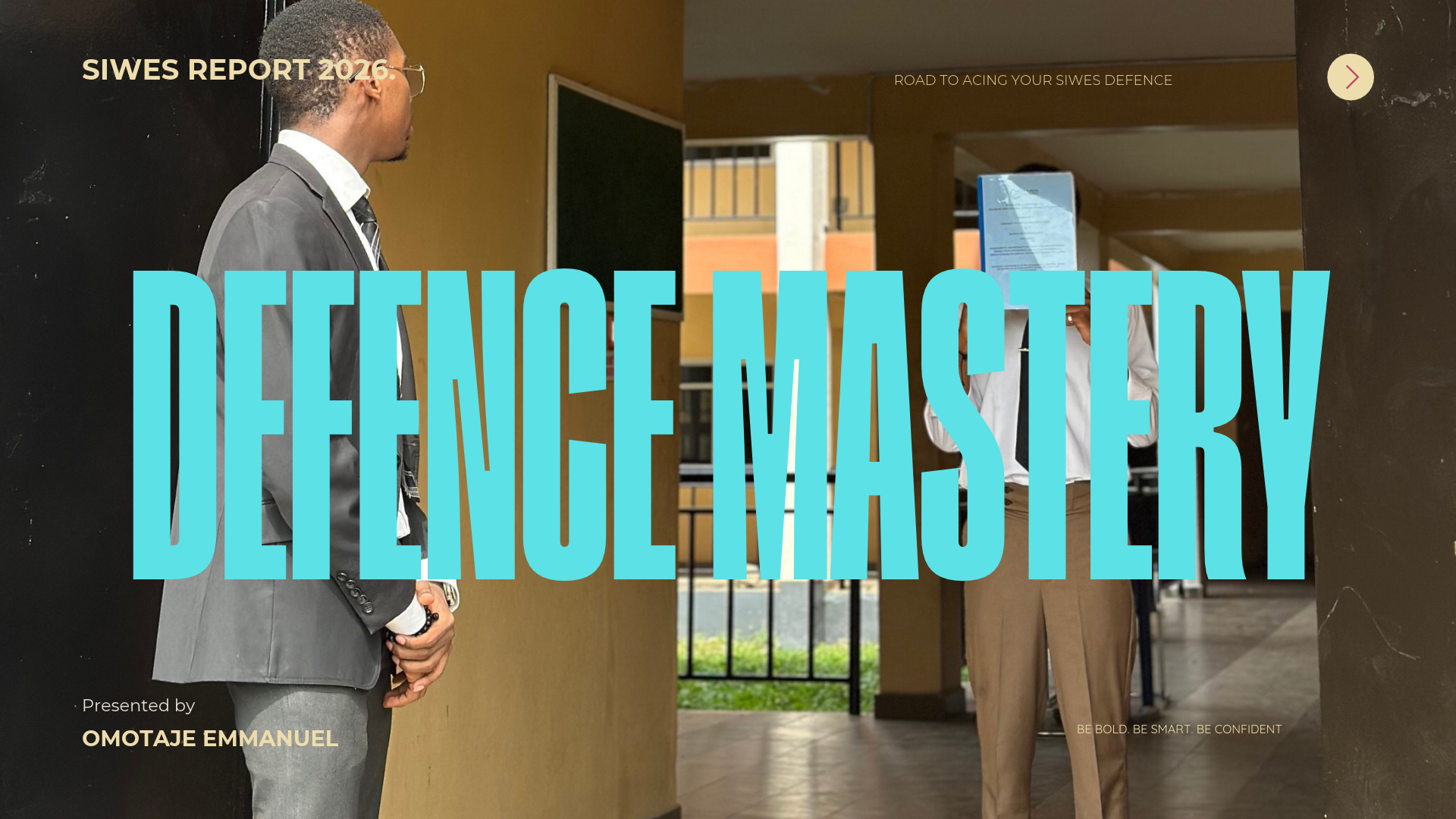
Your defence is an opportunity to demonstrate the knowledge and practical experience you gained during your industrial attachment. So, whether you're nervous about facing your panel or simply wondering what to expect, adequate preparation can make all the difference.
But how do you ace your SIWES/IT defence? Here are eight tips to help you.
1. Dress smart.
While your supervisors are interested in what you know, your appearance also contributes to the impression you make. This isn't an excuse to dress extravagantly. Go for something simple, neat and professional. A clean corporate outfit or an appropriate native attire will do just fine,
Remember, first impressions matter!
2. Know your report and logbook inside out.
Your panel may ask questions based on your SIWES report and logbook, so don't wait until the night before your defence to start reading them.
Go through both documents, rehearse your presentation aloud and prepare for common questions such as:
What did you learn during your industrial attachment?
What challenges did you encounter, and how did you overcome them?
What tools, equipment or software did you work with?
How did your attachment contribute to your professional development?
What recommendations would you make to the organisation or future students?
More importantly, don't just memorise what you wrote. Understand the processes, tools and tasks you were involved in. Your panel may ask you to explain how something works, and that's where genuine understanding comes in.
3. Be confident.
Speak boldly during your presentation. Carry yourself with confidence, not arrogance or unnecessary swagger, but with the calm assurance of someone who understands what is on their slides because, well, you do!
Maintain eye contact with your panel, speak clearly and avoid rushing through your presentation. If you make a mistake, don't panic. Correct yourself and continue.
Yes, you've got this!
4. Don't put anything on your slides that you can't defend.
Every bullet point, diagram, technical term and tool on your slides is fair game for questions. If you cannot explain it, take it out.
Your slides are not a competition to see who can use the most complicated technical terms or squeeze the most information onto a page. Clarity beats unnecessary complexity.
Keep your slides simple, organised and relevant. Remember, your presentation should demonstrate what you understand, not how much information you can copy and paste.
5. Show proof of your work.
Where possible, include photographs of yourself participating in relevant workplace activities. You can also use diagrams, illustrations and screenshots of completed tasks, provided you have permission to share them.
Use genuine evidence of your experience rather than relying on AI-generated images. Your panel wants to see what you actually did, not what artificial intelligence can create.
However, be mindful of confidentiality. Avoid displaying proprietary company information, client details, internal network configurations or any other sensitive material. When in doubt, seek permission before including workplace images or documents in your presentation.
6. Connect what you learnt in school to your IT experience.
One of the things your panel may be interested in is how your classroom knowledge translated into practical experience.
Be prepared to draw a clear connection between what you were taught in school and how you applied that knowledge during your attachment.
For instance, a Computer Engineering student who studied computer networks should be able to explain how that knowledge relates to activities such as network configuration, troubleshooting or maintenance, where applicable.
This demonstrates that your academic training and workplace experience complement each other. It also shows that you understand the relevance of your course beyond the classroom.
7. Manage your time.
Presentation times vary across departments, so confirm your allocated time before the defence. Don't assume you have all the time in the world!
Avoid spending too much time discussing your organisation's history, mission statement or organogram. One slide providing relevant background information should generally be sufficient.
Focus on what matters: your responsibilities, what you learnt, the tools and processes you encountered, the challenges you faced and what you can now do with the skills you acquired.
Rehearse with a timer, avoid reading directly from your slides and ensure your presentation equipment is ready.
8. Stay calm when answering questions.
This is where things can get interesting.
Your panel might ask questions you weren't expecting, challenge your explanations or ask you to clarify something you thought was straightforward. Don't let that throw you off balance.
Listen carefully, understand the question and respond directly. Even when a question feels uncomfortable, remain respectful and professional. Avoid unnecessary arguments or attempts to match anyone's energy.
And if you don't know the answer, it's perfectly fine to admit it. You can say, "I'd need to verify that" rather than bluffing your way through an explanation.
Honest and composed beats confident and wrong.
One more thing: Don't forget to pray!
"Omo, those lecturers threw certain questions I did not expect fr."
A student lamented after experiencing what could only be described as an unexpected question-and-answer session.
Well, sometimes, no matter how much you prepare, your panel might still surprise you. That's why preparation goes beyond memorising your report. Understand your work, stay flexible and be ready to think through unfamiliar questions.
And for those of faith, don't forget to pray. Preparation is important, but there's nothing wrong with committing the process into God's hands as well.
Ultimately, your SIWES defence is an opportunity to demonstrate that your time in the workplace was more than just another academic requirement. Show your panel what you learnt, what you contributed and how the experience has prepared you for the world beyond the classroom.
So, as you step forward to face your panel, remember: understand your work, own your presentation and be ready to defend what you have learnt.
We at The Sting hope these tips help you put your best foot forward. Until next time!
Now, over to you!
How did your SIWES/IT defence go? What was the most unexpected question your panel asked, and what advice would you give someone preparing for theirs?
Share your experience with us through this Google Form: https://forms.gle/PUUBhrTY48SQhRiZ7
Enjoyed this story?
Tap to show the newsroom some love — you can clap as much as you like.