SRC Elections: A Political Saga or an Inclusive Process?

The Sting
22 November 20253 min read
It’s that season again - the period when students decide who leads the Students’ Representatives Council at Abiola Ajimobi Technical University, Ibadan.
This year’s electioneering kicked off with a surprising approach: the call for nominations to the electoral committee lasted for just 24 hours. With the committee now inaugurated and chaired by Isiaka Haliyah, a 400-level computer science student, the release of the eligibility criteria has stirred reactions across campus and opened a floodgate of uncomfortable questions.
Is the committee trying to secure the seat for a predetermined successor? Is the electoral chairman being influenced by the current administration? Why do the eligibility requirements fail to reference any section of the Constitution? And most importantly, why is the Constitution itself inaccessible?
The Students’ Standpoint
A concerned student, Abdulsalam from the 500-level petroleum engineering, in an open letter, demanded clarity. His simple request: quote the constitution. He questioned whether the committee was acting beyond its mandate, leaning more towards a constitutional review panel than an electoral body.

His letter read in part: ”As a student, I am concerned that the committee may be overstepping its mandate — acting as a constitution‑review body rather than an electoral one — and that this could undermine the rights of the student body. Historically, when Chairman Olateju Emmanuel introduced the reform that changed the leadership structure from “Chairman and Chairperson” to “Chairman and ViceChairman,” the decision was made after extensive student consultation. I kindly ask that the current eligibility criteria be revisited, with clear references to a reliable source (such as the student constitution or relevant bye‑laws), and that the process be conducted transparently and without partisan influence. We look forward to a revised set of criteria that reflects the will of the students and upholds our democratic rights.”
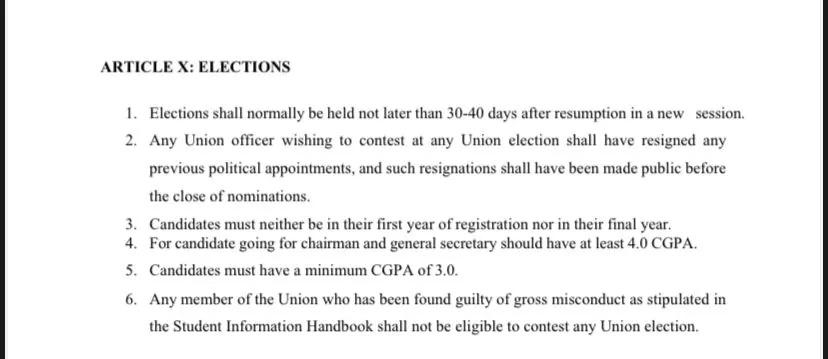
In her response, the electoral chairman cited Article X, insisting that the eligibility criteria were constitutionally backed. But that response exposes a fresh loophole. According to Article X, final-year students are barred from contesting any office — a rule that was conspicuously ignored in the previous administration.
So, the big question now hangs in the air: Will the committee enforce this clause in the coming elections? A Call for Accountability Students expect their leaders and those who manage the process that produces those leaders to be accountable. Trust in the system grows when the people in charge demonstrate transparency, fairness, and openness to scrutiny.
Yet, the simple act of asking questions suddenly attracted bullying and accusations of misogyny, simply because the electoral chairman is female. If genuine concerns are met with hostility, what message does that send to students who might want to raise their own questions?
Will this committee therefore review the eligibility criteria released and reference the constitution as the student requested, or will his questions be swept under the carpet and tagged ‘misogyny’?
]
Will the constitution be released to the students to show transparency, or will the current administration ignore the tensions being generated, questions asked, and show no accountability? At the end of the day, the electoral committee is not above scrutiny. It owes the student body clear answers, not intimidation. Accountability is not optional. It is a duty.
Enjoyed this story?
Tap to show the newsroom some love — you can clap as much as you like.